
U.S. Expat Financial Guide · Singapore
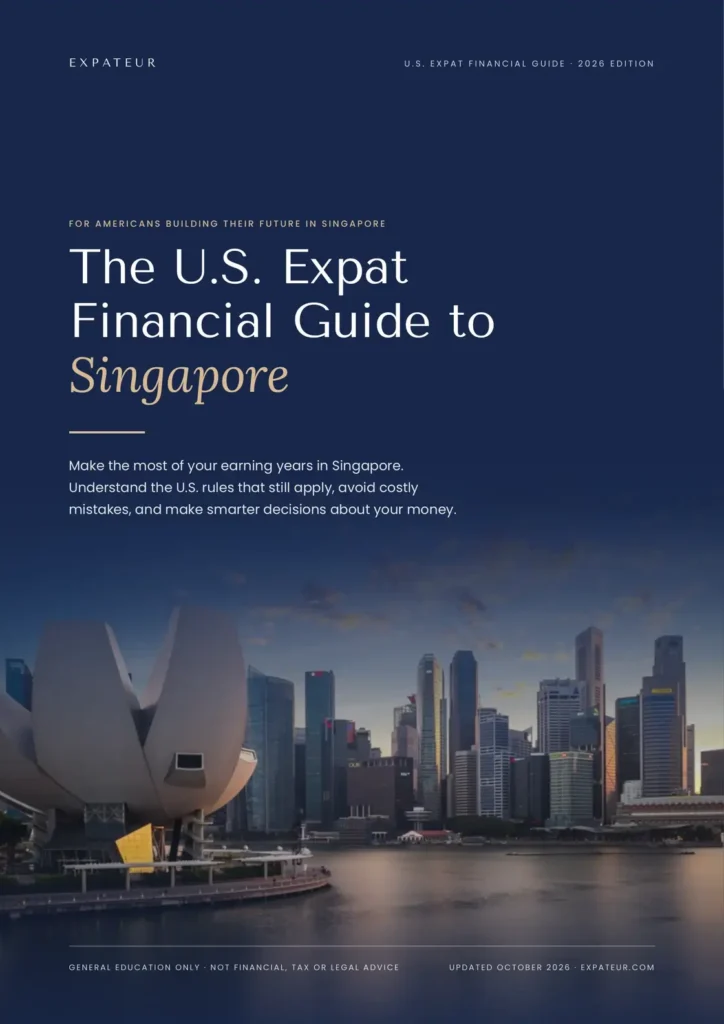
The U.S. Expat Financial Guide to Singapore
Make the most of your earning years in Singapore. Understand the U.S. rules that still apply, avoid costly mistakes, and make smarter decisions about your money.
27-minute readUpdated By Jahtna Hernandez
- Free PDF guideSent to your inbox
- 5 practical partsTaxes to retirement
- Written forU.S. expats in Singapore
Who is this guide for?
For Americans building their future in Singapore
Whether you’re a corporate executive, business owner, or professional working abroad, there’s a lot to consider beyond your salary. From managing investments and retirement accounts back home to planning for your family’s future, we’ll cover the financial decisions worth getting right while you’re here.
Part 01
U.S. taxes for Americans living in Singapore

Living in Singapore doesn’t change your U.S. tax obligations. As a U.S. citizen, you’re still required to file an annual tax return with the IRS, report certain foreign accounts, and follow U.S. rules for your worldwide income.
These rules can be confusing, especially when you’re also paying taxes in Singapore. In this section, we’ll break down what you need to know, which forms may apply, and how to stay compliant while avoiding double taxation.
You still file U.S. taxes every year
One of the biggest misconceptions about moving overseas is that you no longer need to file U.S. taxes once you’re living and working abroad. Unfortunately, that’s not how it works for Americans.
The U.S. taxes its citizens on their worldwide income. That means your salary in Singapore, investment income, rental income, and other taxable earnings generally still need to be reported to the IRS, even if the money never enters a U.S. bank account.
But here’s the important part: filing a U.S. tax return doesn’t automatically mean you’ll owe U.S. taxes. There are special tax provisions for Americans living overseas that can help reduce or even eliminate the U.S. income tax owed on certain foreign earnings. We’ll cover those next.
Your U.S. tax filing deadlines
If you’re living and working overseas, you generally have a little more time to file than someone living in the U.S.
- April 15: The usual U.S. tax deadline. Interest on unpaid federal taxes generally starts after this date.
- June 15: An automatic two-month filing extension for qualifying Americans living abroad.
- October 15: You can generally extend your filing deadline further by submitting Form 4868 on time.
Keep in mind that an extension to file doesn’t mean an extension to pay without interest.
Watch
U.S. taxes abroad, with an international tax lawyer
I sit down with Virginia La Torre Jeker, a U.S. international tax lawyer with over 40 years of experience helping Americans abroad, to go through what every American expat needs to know about filing.
Part 1 · Section 2
How to avoid double taxation on your Singapore income

This is usually one of the first questions Americans ask when they move to Singapore: “If I’m already paying income tax in Singapore, do I have to pay it again in the U.S.?” Not necessarily. The U.S. has two important tax provisions that may help prevent you from paying income tax twice on the same earnings.
The Foreign Earned Income Exclusion (FEIE)
The Foreign Earned Income Exclusion allows eligible Americans living abroad to exclude a certain amount of foreign earned income from U.S. federal income tax. This generally applies to income you earn from working, such as your salary or self-employment income, rather than investment income. To qualify, you need to meet specific requirements, including having a tax home abroad and satisfying certain residence or physical presence rules.
Common form: IRS Form 2555.
Foreign Tax Credit (FTC)
The Foreign Tax Credit works a little differently. It allows you to claim a credit against your U.S. income tax for qualifying income taxes you’ve already paid to Singapore. For example, if you earn your salary in Singapore and pay Singapore income tax on it, you may be able to use those taxes to reduce the U.S. income tax owed on that same income. The credit isn’t always dollar-for-dollar because limits and other rules apply, but it can make a significant difference.
To estimate how much Singapore tax you’ll pay on your salary, try our Singapore Income Tax Calculator.
Common form: IRS Form 1116.
Part 1 · Section 3
Reporting your Singapore bank accounts: FBAR and Form 8938

Opening a Singapore bank account is usually one of the first things you’ll do after moving here. What many Americans don’t realize is that having money in foreign bank accounts can create additional U.S. reporting requirements. Even if you’ve already paid tax on that money, and even if the accounts earn no interest, you may still need to report them.
FBAR: Report of Foreign Bank and Financial Accounts
If the combined value of your foreign financial accounts exceeds US$10,000 at any point during the calendar year, you generally need to file an FBAR. This includes certain bank, savings, and investment accounts held outside the U.S. For example, if you have US$7,000 in a Singapore bank account and US$5,000 in another foreign account at the same time, your combined balance is US$12,000. That means you’ve crossed the reporting threshold. The important thing to understand is that the US$10,000 limit applies to your foreign accounts combined, not individually.
Official form: FinCEN Form 114 (filed separately from your annual tax return.)
Form 8938: Reporting foreign financial assets
Depending on the value and type of your foreign financial assets, you may also need to file IRS Form 8938. For qualifying unmarried taxpayers living abroad, the reporting threshold generally starts when specified foreign financial assets exceed:
- US$200,000 at the end of the tax year, or
- US$300,000 at any point during the year.
Different thresholds apply depending on your filing status and whether you qualify as living abroad. Unlike the FBAR, Form 8938 is filed with your U.S. income tax return.
Behind on all this?
If you’ve missed any U.S. tax filings or foreign account reports while living abroad, don’t ignore it. The IRS has a program called Streamlined Filing Compliance Procedures that may help if it was an honest mistake. A U.S. expat tax professional can help you figure out if you qualify and how to get caught up.
Free PDF
Want your own copy of the full guide?
Get the complete guide by email, so you can save it and come back to it anytime.
Check your inbox
Part 02
Investing as an American in Singapore

You can absolutely keep investing and building wealth while living in Singapore. As Americans, we just have a few extra rules to keep in mind. In this section, we’ll go through what to watch out for, which investment accounts work for Americans abroad, and how to make the most of your time here without running into unnecessary tax headaches.
What happens to your U.S. investment accounts?
If you already have investments back in the U.S., you can generally keep them when you move to Singapore. The catch is that some brokerages restrict what you can buy once you’re living overseas, even if you’ve been a customer for years. Others may let you keep your account but only allow you to hold or sell your existing investments.
You may also be able to invest through a Singapore or international brokerage that accepts Americans, although you’ll still need to consider the U.S. tax rules.
Be careful with foreign funds and ETFs (PFIC rules)
This is one of the most important things to understand when investing as an American abroad. Singapore banks and investment platforms offer plenty of funds that work perfectly well for other expats but can create serious U.S. tax headaches for Americans.
Many foreign mutual funds, ETFs, and unit trusts fall under something called PFIC (Passive Foreign Investment Company) rules. For example, an ETF based in Ireland or Singapore might look like a perfectly normal investment, but as an American, you could end up with complicated IRS paperwork, expensive tax preparation, and potentially much higher taxes. You may even need to file a separate Form 8621 for each fund.
This doesn’t mean every investment outside the U.S. is a problem. But before buying foreign funds or investment-linked insurance products, make sure someone familiar with U.S. tax rules has checked how they’re treated. Just because a local bank or financial adviser recommends something doesn’t automatically mean it’s suitable for Americans.
U.S. investments may be simpler, but there are still rules
Because of the PFIC issue, many Americans abroad consider U.S. stocks, bonds, and U.S.-domiciled funds or ETFs. These can be easier to manage from a U.S. tax perspective, and U.S.-domiciled funds generally avoid the PFIC problems that come with foreign funds.
That doesn’t mean every U.S. investment is automatically right for you. You’ll still want to consider how much risk you’re comfortable taking, what fees you’re paying, and where you might eventually retire. You’ll also need to make sure your brokerage actually allows you to buy those investments while living in Singapore.
Keep investing toward your long-term goals
Being an American abroad doesn’t mean you need to put investing on hold. Whether you’re building wealth, saving for retirement, or planning to return to the U.S. someday, the important thing is finding an approach that works for your situation and U.S. tax obligations.
There are brokerages and investment platforms that work with Americans overseas, although their account requirements and investment options vary. What matters is having a plan you understand, investing consistently, and making sure your money keeps working toward your long-term goals while you’re living in Singapore.
Part 03
Retirement planning for Americans living in Singapore

Living in Singapore can be a great opportunity to build wealth, but retirement savings are something you’ll probably need to manage yourself. If you’re no longer contributing to a 401(k) through work, it’s worth making sure you’re still putting money aside for the future.
Your employer probably won’t contribute to your retirement
If you had a 401(k) or 403(b) back in the U.S., you’re probably used to having money automatically set aside for retirement, sometimes with your employer adding money too. In Singapore, most foreign workers don’t get that same benefit because CPF, Singapore’s retirement savings system, is generally only available to citizens and permanent residents (PRs).
That means if you’re working here on an Employment Pass, you’ll probably need to make your own arrangements for retirement savings.
What happens to your 401(k) and IRA when you move
If you already have a 401(k), traditional IRA, or Roth IRA back in the U.S., you can generally keep those accounts while living in Singapore. You don’t need to close them or withdraw the money just because you’ve moved overseas.
What changes is whether you can keep contributing. For example, once you’ve left your U.S. employer, you generally can’t continue making regular contributions to that employer’s 401(k). You may still be able to contribute to an IRA, depending on your income and U.S. tax situation.
Contributing to an IRA or Roth IRA from Singapore
If you’re using the Foreign Earned Income Exclusion (FEIE), keep in mind that income excluded under the FEIE doesn’t count as eligible compensation for IRA contributions. So if you’re excluding your entire salary, you might not be able to contribute to a traditional or Roth IRA that year unless you have other qualifying income.
You can still have plenty of money available to save and invest, but that doesn’t automatically mean you’re eligible to put it into an IRA. It’s worth checking with your U.S. tax adviser before making contributions.
Don’t forget about U.S. Social Security
If you’re working for a Singapore employer, you’re generally no longer paying into U.S. Social Security, which means you’re not earning new credits toward your future benefits. The credits you’ve already earned back home remain on your record, but your years working in Singapore generally won’t add to them.
It’s different if you’re self-employed, since Americans working for themselves abroad generally still owe U.S. self-employment tax and can continue earning Social Security credits.
Be careful with Singapore’s SRS
Singapore has a retirement savings program called the Supplementary Retirement Scheme (SRS), which can offer Singapore income tax benefits. But as an American, you shouldn’t assume the IRS will treat it the same way.
The U.S. doesn’t automatically recognize those local tax benefits, and investments held inside the account can create additional U.S. tax or reporting complications. Before contributing, have someone familiar with both countries’ tax rules check whether it actually makes sense for you.
Think about where you might eventually retire
You might plan to return to the U.S., stay in Singapore, or retire somewhere completely different. That decision can affect how your retirement savings are taxed when you eventually start withdrawing money.
For example, qualified Roth IRA withdrawals are generally tax-free in the U.S., but another country doesn’t necessarily have to treat them the same way. So if you think you might retire outside the U.S., it’s worth considering that before deciding where to keep your long-term savings.
Keep saving, even if retirement is still years away
If you’re earning well in Singapore, it’s easy to focus on your lifestyle, housing, travel, and everything else that comes with living abroad. But these can also be some of your most valuable years for building retirement savings.
You don’t need to have every detail figured out today. The important thing is to decide how much you want to put aside, find an investment arrangement that works for you as an American, and stay consistent. Your future self will appreciate it.
Part 04
Banking and managing money between the U.S. and Singapore

Managing money between the U.S. and Singapore doesn’t have to be complicated, but it’s worth getting a few things set up properly. You want your accounts, credit cards, and everyday banking to work smoothly on both sides, without having to deal with unnecessary problems while you’re overseas.
Keep your U.S. bank accounts and credit cards active
If you already have a U.S. checking account and credit card, it’s usually worth keeping both. You’ll still need ways to pay bills back home, receive IRS refunds, and maintain your U.S. credit history. And if you eventually return to the U.S., having those accounts already in place makes life easier.
Just check that your bank allows you to keep your accounts while living in Singapore. Some U.S. banks restrict services or close accounts when customers move overseas, so it’s better to know their rules before you relocate.
Make sure you can still access your accounts from overseas
You’ll quickly realize how often U.S. banks want to text you a security code just to log in. Keeping a U.S. phone number that works in Singapore can save you a lot of frustration.
Some banks don’t accept internet-based phone numbers for verification, so check that your setup works before you leave. It’s also worth switching to paperless statements and making sure your bank has your current contact information and residential address.
Part 4 · Section 2
Opening a bank account in Singapore

Opening a bank account in Singapore is usually pretty straightforward once you have the right documents. You’ll generally need your passport, work pass or in-principle approval (IPA) letter, a Singapore phone number, and proof of your local address. Requirements vary by bank, so check what yours accepts before applying.
Get your proof of address sorted early
This is often what slows people down when they first arrive, especially if they’re staying in temporary housing and don’t have any bills or a lease in their name.
When I opened my DBS account, a representative told me they could accept a temporary address letter from my employer. Not every company provides one, but it’s worth asking before you move. Mine didn’t, so I ended up adding my name to my partner’s lease instead, which took a little longer.
Just keep in mind that banks have different requirements, and some won’t accept a lease on its own. Check what your bank accepts so you’re not going back and forth trying to get documents together.
Expect a few extra questions as an American
Singapore banks will generally ask about your U.S. tax residency and request your Social Security number because of FATCA, a U.S. law that requires foreign financial institutions to report certain accounts held by Americans.
It’s completely normal, although you may be asked for additional information before your account is approved.
Choose a bank that makes everyday life easier
When comparing banks, look at account fees, minimum balances, ATM access, mobile banking, and how easily you can manage different currencies.
If you’ll regularly transfer money between Singapore and the U.S., compare exchange rates and fees too. Your bank can handle international transfers, but that doesn’t necessarily mean it’ll give you the best deal. Services like Wise are worth comparing, especially for larger transfers.
Know how much of your money is protected
Eligible Singapore dollar deposits are insured up to S$100,000 per depositor, per bank under Singapore’s deposit insurance scheme. That limit applies across your eligible accounts at the same bank, not separately to each account.
Foreign currency deposits, including USD balances, aren’t covered. If you’re keeping a significant amount of cash in Singapore, it’s worth understanding these limits and considering whether spreading your deposits across different banks makes sense.
Part 4 · Section 3
Managing SGD and USD

If you’re earning in Singapore dollars but still have expenses or financial commitments back in the U.S., you’ll probably be managing money in both currencies. There’s no perfect way to split it, but a little planning can help you avoid unnecessary fees and exchange-rate surprises.
Keep your money in the currency you’ll need
If you’re paying rent, bills, and everyday expenses in Singapore, it makes sense to keep that money in SGD. If you’re saving for a house back in the U.S. or have upcoming expenses in dollars, consider keeping that money in USD.
Think about what you’ll need over the next year or two and try to keep those savings in the currency you’ll actually spend them in.
Keep some emergency savings in Singapore dollars
If you’re living and working in Singapore, it’s worth keeping enough SGD available to cover several months of expenses.
That way, if you lose your job or have an unexpected bill, you won’t need to rush to transfer money from the U.S. or worry about the exchange rate that day.
Don’t stress about finding the perfect exchange rate
It’s tempting to wait for SGD or USD to hit the perfect rate before moving money, but nobody can reliably predict where currencies are going.
If you regularly need U.S. dollars, converting smaller amounts over time can help spread out your exchange-rate risk rather than moving everything on one day. It won’t guarantee a better rate, but it can make the process more manageable.
Keep records when moving large amounts
If you’re transferring a large amount between your own U.S. and Singapore accounts, keep the statements showing where the money came from and where it went.
Moving your own money generally isn’t taxable by itself, although certain foreign currency gains can have U.S. tax consequences. Banks may also ask questions about large transfers, so keeping clear records can save you a lot of back and forth later.
Part 05
Protecting your family and financial future

When you’re living overseas, it’s worth making sure your insurance and financial protection actually work for you and your family, both in Singapore and wherever you might move next. You don’t need every type of coverage available, but there are a few important things worth checking.
Make sure your health insurance covers what you need
Singapore has excellent healthcare, but hospital bills can get expensive, especially for foreigners. If your employer provides health insurance, check what’s actually covered, including hospital stays, annual limits, deductibles, and whether your partner or children are included. You’ll also want to know what happens if you leave your job or move to another country, since employer coverage often ends when your employment does.
Our Cost of Living Calculator can help you estimate private health insurance costs.
Life insurance can protect the people who depend on you
If your partner or children rely on your income, life insurance can help cover their expenses if something happens to you. Think mortgage payments, school fees, everyday bills, and anything else your family would need financially. If you already have a U.S. policy, check whether it still covers you while living abroad. If you’re considering a Singapore policy, find out whether you can keep it when you move and how the U.S. treats it for tax purposes, especially if it includes an investment or savings component.
Think about what happens if you can’t work
Your health insurance might cover medical bills, but what happens to your income if you’re seriously ill or injured and can’t work for months? Disability or income protection insurance can help replace some of your lost earnings, depending on the policy. If you already have coverage through work, check how much it pays, how long it lasts, and whether it ends when you leave your employer.
Understand what critical illness insurance actually covers
Critical illness insurance typically pays you a lump sum if you’re diagnosed with a serious illness covered by your policy. Unlike health insurance, which helps pay medical bills, this money can help with everyday expenses, time off work, or other costs while you recover. Just check the conditions carefully, because not every illness or diagnosis qualifies.
Part 5 · Section 2
Planning for your children’s education in Singapore

If you’re raising kids in Singapore, international school fees can easily become one of your biggest expenses, especially with more than one child. It’s worth planning ahead so school costs don’t end up taking a bigger bite out of your savings and long-term financial goals than you expected.
Budget for more than just tuition
International schools in Singapore can cost tens of thousands of Singapore dollars per child every year, with some exceeding S$50,000 once everything is included. And tuition is only part of it. You’ll also need to think about enrollment fees, school buses, uniforms, lunches, trips, and activities. Our International School Finder lets you compare schools and their fees, while our Cost of Living Calculator helps you see how those costs fit into your household budget. If you’re still deciding where to live, our Neighborhood Finder suggests three areas based on where you’ll work and your children’s school.
Ask your employer about school fee assistance
If you’re moving to Singapore for work, ask whether your company offers an education allowance. Some employers cover tuition, others contribute a fixed amount, and some don’t offer anything. It’s worth discussing as part of your relocation package, especially if you have more than one child. Just check exactly what’s included and whether the benefit is taxable in Singapore, so you know what it’s actually worth.
Check whether your U.S. 529 plan can help
If you already have a 529 education savings plan back in the U.S., don’t assume you can use it for international school tuition in Singapore. U.S. rules allow up to US$20,000 per child per year for certain qualifying K–12 expenses starting in 2026, but that doesn’t mean tuition at a school overseas qualifies. Before withdrawing anything, check with your plan provider and a U.S. tax professional so you don’t accidentally end up with taxes or penalties.
Think about the costs as your children get older
School fees generally increase as children move into higher grades, so a school that fits your budget today might cost considerably more in a few years. If you have multiple children, look at what you’ll be paying when they’re all in school, not just what it costs right now. It’s also worth thinking about whether your children will eventually attend university in the U.S. or elsewhere, since that could affect how much you want to save and in which currency.
Part 5 · Section 3
Estate planning for Americans living abroad

If you have savings, investments, property, or family in more than one country, it’s worth making sure everything is organized if something happens to you. The last thing you want is your family trying to figure out how to access your money or manage your affairs across two countries during an already difficult time.
Review your will after moving abroad
If you already have a will in the U.S., make sure it still reflects your wishes and accounts for any assets you’ve acquired overseas. You won’t necessarily need a new one, but if you own property or significant assets in Singapore, it’s worth asking an estate lawyer whether a separate Singapore will would help. If you have wills in both countries, they need to work together so one doesn’t accidentally cancel the other.
Check who your accounts will go to
Your 401(k), IRA, life insurance, and other financial accounts may have beneficiaries you’ve already named. Make sure those details are still correct, because beneficiary instructions can determine who receives the money regardless of what your will says. Singapore insurance policies have their own nomination rules, and if you’re a permanent resident with CPF savings, those require a separate CPF nomination too.
Be careful if your spouse isn’t American
If you’re married to someone who isn’t a U.S. citizen, there are different U.S. estate and gift tax rules to consider. This can matter when transferring substantial assets to your spouse or planning what they’ll inherit. If you’re building wealth across countries, it’s worth getting cross-border estate advice before making major decisions.
Make a plan for your children
If you have young children, think about who you’d want to care for them if something happened to both parents. It’s especially important when your closest family might be in the U.S., Australia, or somewhere else entirely. Talk to the person you’ve chosen and get advice on how to document your wishes so the arrangements are as clear as possible.
Decide who can handle things if you’re unable to
A will deals with what happens after you die, but it’s also worth planning for what happens if you’re alive and unable to make decisions yourself. You may need someone to manage your finances, deal with banks, or make healthcare decisions. Powers of attorney and other legal documents can help, but documents from the U.S. may not automatically work in Singapore, so check what you need in each country.
Make it easy for your family to find everything
Make sure someone you trust knows where to find your will, insurance policies, account information, and important contacts. You don’t need to hand over passwords or access to your money. Just having everything organized can make a huge difference if your family ever needs it.
Common questions
Questions Americans in Singapore often ask
Is there a tax treaty between the U.S. and Singapore?
No. The U.S. and Singapore don’t have a comprehensive income tax treaty, and there’s no Social Security agreement between them either. Americans rely on U.S. rules, mainly the Foreign Earned Income Exclusion and the Foreign Tax Credit, to avoid paying tax twice. It also means the IRS doesn’t give Singapore’s CPF or SRS the tax breaks they get locally.
The two countries do have a FATCA agreement, which is why Singapore banks ask for your U.S. tax details.
Can Americans use Endowus, Syfe or StashAway?
Not at the moment. Endowus, Syfe and StashAway all say on their help pages that they can’t open accounts for U.S. citizens or U.S. tax residents (checked October 2026).
If you find a Singapore platform that does accept Americans, check where its funds are based. Funds based outside the U.S. can fall under the PFIC rules covered above.
What happens to my 401(k) if I move to Singapore?
You can usually leave it where it is. Your 401(k) stays invested and keeps its U.S. tax treatment while you live in Singapore. You can’t keep contributing once you’ve left that employer, but you can roll it into an IRA if you’d rather manage it yourself.
Before you move it, check that the new provider accepts customers with a Singapore address, since some limit what people living abroad can do. Withdrawals before age 59½ generally come with a 10% penalty on top of income tax.
How does the IRS treat CPF?
This mostly matters if you’re a Singapore permanent resident, since Employment Pass holders don’t contribute to CPF. The IRS hasn’t issued specific guidance on CPF, so U.S. tax professionals don’t all treat it the same way.
In general, your own contributions don’t reduce your U.S. tax, your employer’s contributions and the interest may count as U.S. taxable income, and your CPF accounts may need to be reported on your FBAR and Form 8938. Ask a U.S. expat tax professional how to treat yours, and keep it consistent from year to year.
In closing
Where do you stand?

We’ve covered a lot in this guide, so here’s a quick way to see where you stand. Go through the checklist and tick off the things you’ve already sorted out. Anything you haven’t checked off is something you might want to look into next.
Your financial checklist
0 of 7 complete
You don’t need everything figured out today. Just start with what matters most.
What comes next
Everyone’s financial situation is different. Whether you’re building wealth, planning for retirement, or thinking about your family’s future, the goal is to make the most of your time in Singapore while planning for what’s ahead.
We hope this guide has been helpful. Feel free to save a copy to come back to whenever you need it. And if you’d like advice tailored to your situation, we can connect you with a qualified financial adviser who specializes in helping Americans in Singapore.

Jahtna is an American living in Singapore and the founder of Expateur, where she writes practical guides and builds free tools for expats on moving, housing, schools, money and everyday life. This guide draws on her own move, conversations with U.S. tax and financial professionals, and the official IRS, FinCEN, IRAS, CPF and MAS sources linked throughout.
Disclaimer
This guide is provided for general educational and informational purposes only. It does not constitute financial, investment, tax, legal, accounting, insurance or other regulated advice, and it does not take into account the personal circumstances, financial situation, objectives or needs of any reader. Before making any financial, investment, tax, legal or insurance decision, obtain advice specific to your situation from a properly licensed professional. Expateur is not licensed by the Monetary Authority of Singapore to give financial advice and is not a registered investment adviser in the U.S. If we introduce you to a financial professional, we do so only with your consent, and we may receive a referral fee from them. Figures and rules in this guide reflect our understanding as of the last reviewed date and can change.
Keep planning
More free tools
 Calculator
Singapore cost of living calculator
 Calculator
Singapore rental budget calculator
 Calculator
Singapore income tax calculator
 Matching tool
Singapore neighborhood finder
 Matching tool
Singapore international school finder
 Checklist
Singapore rental checklist
 Checklist
Moving to Singapore checklist 2026